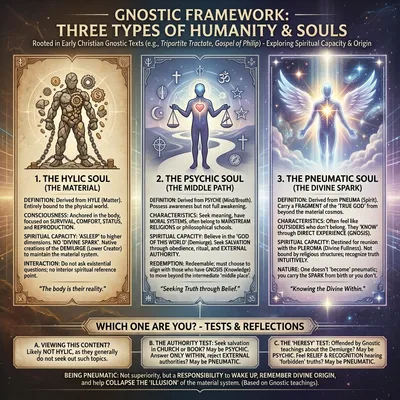
The ancient Gnostic classification system divides humanity into
three distinct spiritual categories: Hylic, Psychic, and
Pneumatic. This framework, found in texts like the Tripartite
Tractate, explains how different levels of consciousness
determine an individual’s relationship to the material world and
the divine source.
The Three Soul Classifications
Type
Nature
Primary Focus
Spiritual Destiny
Hylic
Material (Hyle)
Physical survival, sensory pleasure, and bodily
instincts.
Dissolution into the material realm.
Psychic
Soul/Mind (Psyche)
Morality, religious doctrine, and external faith.
The “Middle Place” (an intermediate realm).
Pneumatic
Spirit (Pneuma)
Internal Gnosis and the uncreated divine spark.
Return to the Pleroma (divine fullness).
Key Concepts in the Framework
The Demiurge: In Gnostic thought, the
physical world was created by a lower, often ignorant deity
called the Demiurge. Hylics are considered
its natural creations, Psychics are its
faithful servants, and Pneumatics are seen as
“spiritual exiles” carrying a spark from the true, higher God.
Gnosis vs. Faith: The system distinguishes
between Psychic faith (belief in external
authorities, scriptures, and rules) and
Pneumatic Gnosis (direct, internal, and
experiential knowledge of the divine).
Innate Nature: According to the
Tripartite Tractate, these categories are largely
deterministic. One does not “evolve” into a Pneumatic; rather,
a Pneumatic eventually “remembers” their pre-existing
spiritual origin through an awakening.
The Role of the Archons: These are the
planetary regents or “jailers” of the Demiurge. While Hylics
are unaware of them and Psychics obey them, Pneumatics are
believed to possess the knowledge required to bypass them and
exit the reincarnation cycle.